
Processing Workflow
Baseline Distance
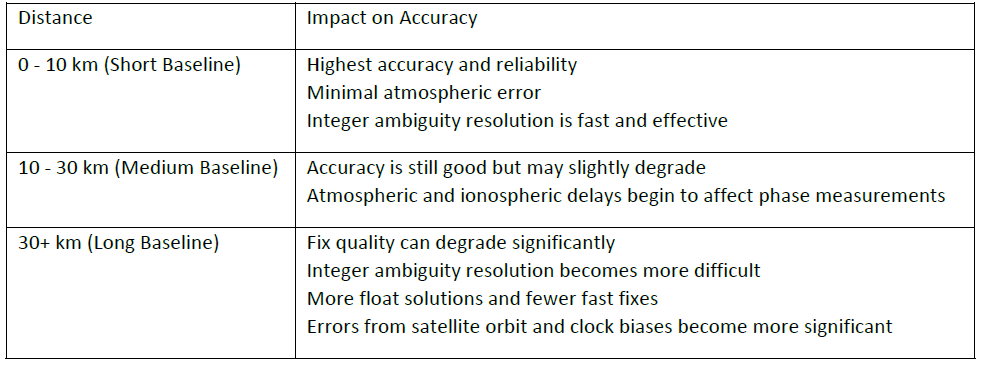
Positioning accuracy depends heavily on the distance between the rover (drone receiver) and the base station. Shorter baselines typically result in higher precision due to reduced atmospheric and orbital error impact. The table below illustrates how varying baseline lengths can affect post-processing outcomes:
Mission Duration
The total time span of your GNSS data collection determines the robustness of your solution.
Recommended: Minimum of 15 minutes where practical. A 10-minute duration is considered the minimum viable threshold and may suffice if all other conditions such as baseline distance, satellite geometry, and signal quality are strong.
Why it matters: Longer durations provide more data for convergence and error mitigation, especially useful in marginal satellite visibility or challenging environments.
Risks of short durations: Missions shorter than the recommended duration minutes may lead to unstable fixes or incomplete ambiguity resolution.
Tip: Give the flight a static window at each end
Start the aircraft's GNSS log while it sits stationary under open sky for 3-5 minutes before takeoff, and keep it logging, stationary, for another 3-5 minutes after landing.
KlauPPK processes the trajectory in both directions; forward from the start of the log and in reverse from the end and combines the two. The weakest epochs in any dataset are therefore the first and last. If the log begins at the moment of takeoff, the engine is asked to resolve ambiguities from cold while the aircraft is already accelerating and changing attitude. A stationary period gives each pass clean, low-dynamics data to fix on before it reaches anything you care about, and it means both directions arrive at your first and last camera events already fixed rather than converging through them.
Observation Interval
The interval between GNSS observations directly affects the quality and granularity of post-processing. Most providers offer data at intervals such as 1, 5, 15, or 30 seconds.
Recommended: 1-second intervals
Why it matters: Shorter intervals capture more detailed phase and signal information, which improves solution quality, especially for high-dynamics platforms like drones.
Trade-offs: Longer intervals (e.g. 5–30 seconds) may miss critical transitions, reduce redundancy, and increase the chance of cycle slips.
Some providers decimate their high-resolution data after a set retention period, typically 30 to 45 days by downsampling to lower intervals. To ensure optimal results, it’s recommended to process or retrieve the relevant GNSS data soon after the flight mission, before any data decimation occurs.
Satellite Geometry (DOP Values)
The quality of GNSS positioning is directly influenced by satellite geometry, which is measured using Dilution of Precision (DOP) values.
Target low DOP values: Ideal positioning occurs when PDOP is below 2.0, indicating strong satellite geometry and minimal distortion.
Check forecasted DOP windows: Some GNSS planning tools offer satellite visibility charts—schedule missions during periods of favorable geometry.
Avoid obstructed environments: Tree cover, buildings, and terrain can reduce satellite visibility, increasing DOP and lowering accuracy.
Use multi-constellation receivers: Access to GPS, Galileo, GLONASS, and BeiDou improves satellite distribution and reduces DOP.
Antenna Setup & Mounting Guidelines
Proper antenna installation is critical to achieving high-precision GNSS results. Even with quality receivers and correction data, poor mounting can introduce multipath errors, signal loss, and degraded accuracy.
Placement Location
• Clear sky view is essential. install antennas in open areas with minimal obstructions (trees, buildings, etc.).
• Avoid reflective surfaces nearby (metal, glass, water) to reduce multipath interference.
• For mobile platforms (e.g. drones or vehicles), ensure the antenna is centered and isolated from
vibration and movement.
Avoiding Interference
• Keep antennas away from RF sources like radios, cellular transmitters, or satellite uplinks.
• Maintain at least a 3 meter separation from other antennas or electronics to prevent cross-talk and jamming.
Process your next flight with KlauPPK
Start a 14 day, full-function trial and test KlauPPK with your own project data. No credit card required.